Click here to
return to Tim Kelley’s Waterfowl Outfitters Unlimited.
No
crying fowl with these new rules
Six-duck daily limit to include increase in pintail
taking
August 29, 2010
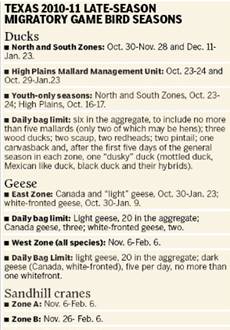
Texas’ waterfowl hunters will see a slight liberalization of
the duck bag limit, statewide, and the Canada goose bag limit in the western
half of the state during the 2010-11 seasons.
This season, Texas duck hunters will be allowed to include
as many as two pintails in the six-duck daily limit. It will mark the first
season in more than a decade that Texas waterfowlers can take more than one of
the highly regarded pintail per day.
In the West Goose Zone, which covers the western half of the
state, the five bird daily bag limit of “dark” geese (Canada and white fronted)
may include as many as five Canada geese. The increases were part of the
package of regulations governing migratory game bird hunting adopted Thursday
by the Texas Parks and Wildlife Commission during its meeting in San Antonio.
The increase in the pintail bag limit is a result of changes
in federal waterfowl management strategies for the popular species and a slight
increase in the breeding population of pintail.
Population grows
This spring, waterfowl managers estimated the breeding
population of pintail at 3.50 million birds, up from 3.22 million in 2009 and
the highest since the 3.55 million birds in 1997, the most recent year in which
hunters were allowed to take more than one pintail per day. “Pintail numbers
and habitat conditions are pretty good, this year,” Dave Morrison, waterfowl
program leaders for the Texas Parks and Wildlife Department, told the TPW
Commission.
This duck season will see a repeat of this past season’s
delayed opening of the hunting season on “dusky” ducks. While the general duck
season in Texas’ North and South Duck Zones will open Oct. 30, the season for
“dusky” ducks (mottled, Mexican-like and black ducks) will open Nov. 4.
The five-day delay is designed to reduce harvest of mottled
ducks, a Gulf Coast resident duck that has seen a slow, steady population
decline. Making “dusky” ducks off limits to hunters for the first five days of
the season is aimed at reducing harvest of mottled ducks by about 20 percent, a
target set by federal waterfowl managers.
An expanding population of some species of Canada geese
which use the western portion of the Central Flyway triggered the slight
increase in the bag limit for dark geese in Texas’ West Goose Zone.
TPWD received about 600 public comments concerning the
agency’s proposed waterfowl season regulations, Morrison told the commission.
About 350 of those comments supported the regulations
package, with about 250 voicing opposition to parts of the proposals.
Duck season dates were the focus of the majority of
opposition to the proposed regulations, accounting for about 120 of the
comments.
The majority of those comments —113— wanted TPWD to set duck
season to close on Jan. 30, the latest closing date allowed under the federal
frameworks states must use when setting seasons for migratory birds.
TPWD recommended, and the TPW Commission approved, closing
the duck season on Jan. 23.
Most of the push for the latest-possible duck season closing
came from waterfowlers in North Texas. Hunters there argue their hunting
success — particularly for mallards — is best during January and want the
season to run as late as possible.
Dates debated
For more than a half century, until political pressure from Mississippi’s
Sen. Trent Lott in the late 1990s pushed the U.S. Fish and Wildlife Service to
extend the latest closing date for duck season to the final Sunday in January,
duck seasons closed no later than Jan. 20.
The late-January closing date has been available,
nationwide, only since 2002.
Waterfowl managers almost unanimously prefer to close the
season earlier in January, citing benefits to ducks with little or no impact on
hunter opportunity or success rates. Amid-January closing allows duck more time
to forage and feed unmolested, building necessary body condition for the
grueling northern migration and the rigors of breeding and nesting. One of the
limiting factors in duck productivity is body condition of ducks when they
leave wintering grounds. Many duck species begin pair bonding during January
and late-season hunting can impact those pair ponds or, if a mate is lost,
force the surviving duck to unnecessarily expend precious energy looking for a
new mate.
Harvest data indicates duck hunter success in Texas, as
gauged by the average number of birds taken per day of hunting, is not better
in January than October, November or December —in fact, January almost
invariably sees the lowest ducks-per-day average of the season. And data
reflects that to hold true over seasons with mild winters as well as those with
severely cold winters, Morrison said.
shannon.tompkins@chron.com