Click to return
to Tim Kelley’s Waterfowl Outfitters Unlimited.
Another big
season is blowin' in the wind
Good weather will bring plenty of
ducks, geese
By SHANNON TOMPKINS
Copyright 2010 Houston Chronicle
July 11, 2010
Shannon Tompkins Chronicle
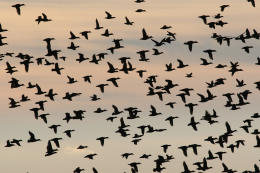
Conditions are favorable now, but waterfowlers will need
cold fronts this autumn to push birds down the flyway.
Population remains high
Each May and June since 1955, biologists from the United
States Fish and Wildlife Service and the Canadian Wildlife Service have
conducted aerial surveys of major duck breeding nesting areas on prairies of
the north-central U.S. and south-central Canada and the boreal forest of
central Canada.
They estimate the number of the 10 most populous duck
species: mallard, pintail, scaup, gadwall, wigeon, canvasback, redhead,
blue-winged and green-winged teal and northern shoveler.
Those numbers provide a population index valuable in
tracking trends in the overall duck population and the ups and downs of
individual species.
This year’s breeding population survey yielded an index of
40.9 million ducks, the fourth highest since 1999’s record index of 43.4
million ducks.
The 2010 population index is a little less than twice the 24
million ducks counted during the late 1980s and early 1990s, when the
combination of a decade-long drought and conversion of grasslands to
agricultural fields shrank duck-nesting and brood-rearing habitat and duck
numbers plummeted.
Texas waterfowlers know local weather plays a crucial role
in their fortunes during autumn and winter hunting seasons. A foggy morning is
great for goose hunters. Duck hunters benefit from a strong south wind and a
sheet of low clouds. And a clear, calm day typically spells a slow hunt for
both.
But the vagary of weather far from Texas has a more
fundamental impact on Texas waterfowlers. It largely determines just how many
ducks and geese — and how many young, more gullible birds - travel down the
Central Flyway to Texas.
This year, weather is blowing good fortune to ducks, geese
and Texas waterfowlers. A wet winter, spring and summer on major duck nesting
areas in the north-central United States and south-central Canada along with a
strong population of ducks returning to those areas portends another in a
decade-plus string of large fall flights.
And an unusually early and fairly dry spring in the far
North means Texas goose hunters will likely see a much different season than
the hideously unproductive one they endured last year.
"We're looking at an awfully good year, both for ducks
and geese," said Dave Sharp, Denver-based U.S. Fish and Wildlife Service
migratory bird biologist and member of the Central Flyway Council. "The
weather did the birds a favor."
Recently released data from this spring's 56th annual aerial
survey of the major duck nesting areas pegged the population index of breeding
ducks at almost 41 million birds, 21 percent above the 1955-2009 average and
almost exactly the same number as in 2009.
Of the 10 duck species surveyed on the nesting grounds, only
three - pintail, scaup and wigeon - are below their long-term (1955-2009)
population averages.
Strength in numbers
Some ducks - gadwall, green-winged teal, shoveler and
redhead - are more than 50 percent above their long-term average. Two of those
species -gadwall and green-winged teal -are among the top three ducks taken by
Texas waterfowlers.
Blue-winged teal, the other duck in the Texas Top Three, are
36 percent above their long-term average. And this year's breeding population
index of 6.32 million birds is well above the 4.7 million required to trigger a
16-day September teal season. That season is set to run Sept. 11-26.
Those ducks found favorable breeding and nesting habitat
when they hit the northern prairies. The "May pond count," a survey
of wetlands conducted at the same time as the duck breeding population survey,
estimated 6.66 million individual wetlands on the northern nesting grounds, up
4 percent from a year ago and 34 percent above the long-term average.
That number of wetlands hasn't diminished as summer burns on
and perhaps has increased because of continued precipitation.
"Rain hasn't stopped," Sharp said. "Folks on
the ground in the Dakotas say its as green and lush right now as it was when
they did the surveys."
That abundance of wetlands and rain-soaked grasslands means
duck production should be outstanding.
Because habitat conditions were so good in the southern
portions of the nesting grounds, many ducks stopped there instead of moving
father north. That gave them a head start on nesting, Sharp said. And because
they got an early start and the wet conditions delayed farming operations,
fewer nests were lost when farmers prepared their fields.
Also, the continuing good conditions will benefit re-nesting
efforts and help provide good habitat for brood rearing
"There should be a lot of little ducks produced this
summer," Sharp said.
The same should occur with geese, particularly snow geese,
farther north.
Timing just right
Snow goose production is tied to timing of the spring thaw
on the birds' Arctic and sub-Arctic nesting areas. The big birds have a narrow
window in which to nest, hatch their young and raise them to fledging.
In 2009, snow and freezing weather held on well into June on
major snow goose nesting colonies, resulting in almost no nesting success.
Juvenile snow geese make or break a hunting season on the
Texas coastal prairies. Adult snow geese are famously wary - juveniles aren't.
Last season, with wintering flocks consisting almost
exclusively of adult birds, hunting was so unproductive many goose hunters
simply gave up.
Things should be different this year.
"It was an extremely early spring," Sharp said.
In parts of Ontario, "ice-out" was as much as a
month ahead of normal.
Because snow goose nesting colonies are so isolated,
firsthand reports from the areas are hard to come by. But the few reports
sifting south from tundra are of strong nesting efforts and good early
production.
White-fronted geese - "speckled-bellies" or just
"specks" to most Texas waterfowlers - also are benefiting from
weather on their main nesting grounds.
Unlike snows, which nest in dense colonies, whitefronts nest
over broad reaches along river shorelines, deltas and other waterways. And
because whitefronts nest close to waterways, they risk having their nests
destroyed by flooding.
"The years we have lowest whitefront production are
years when there's flooding along those rivers," Sharp said.
This has been a dry spring and summer in most whitefront
nesting areas, including interior Alaska, which produces about one-third of the
specks that winter in Texas, Sharp said. And early reports from those areas
indicate the bare-chested geese are having at least an average nesting success.
"I can't see how we can't have a great year, both for ducks
and geese," Sharp said.
Of course, as Texas waterfowlers know, that depends on the
weather. Come autumn, we'll need some serious cold fronts to push those birds
down the flyway.
SURVEY SAYS
Estimated duck breeding population, in millions, on
traditionally surveyed areas:
2010: 40.9
2009: 42.0
2008: 37.3
2007: 41.2
2006: 36.2
2005: 31.7
2004: 32.2
2003: 36.2
2002: 31.2
2001: 36.1
2000: 41.8
1999: 43.4
Source: U.S. Fish and Wildlife Service.